
ADAPTIVE CAPABILITY DIAGNOSTIC
The starting point for building organizational adaptability.
A comprehensive diagnostic that reveals your organization's adaptive maturity, identifies critical capability gaps, and provides a strategic roadmap. Run personally by Kelly across six capability dimensions.
The Adaptive Capability Diagnostic is the entry point into ACE work. Not familiar with the framework yet? Start with The Approach.
THE QUESTION MOST CEOS ARE ASKING
Most CEOs reaching out are dealing with 3, 5, maybe 7 simultaneous transformations. Changes keep failing or stalling. Your team is maxed out. You're spending significant money on consultants for every transformation.
But before you invest in solutions, you need to answer:
-
Where exactly are our capability gaps?
-
Why do changes keep failing to take root?
-
What infrastructure do we need to build first?
-
Should we focus on governance? Leadership? Culture? Systems?
This diagnostic answers those questions with evidence and specificity.
WHAT MAKES THIS DIFFERENT
Most change assessments evaluate readiness for a specific initiative. This evaluates your enterprise-level capacity to continuously evolve.
Other assessments give you:
-
Generic maturity scores
-
High-level recommendations
-
Vague "you should improve X" advice
This diagnostic gives you:
-
Evidence-based diagnosis across 6 specific capability dimensions
-
Root cause analysis of why changes aren't succeeding
-
Prioritized roadmap showing exactly what to build and in what sequence
-
90-day action plan to start strengthening immediately
You get strategic clarity, not just another consultant report.
THE SIX DIMENSIONS
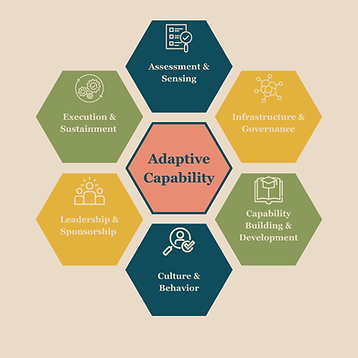
The diagnostic evaluates your organizational adaptive maturity across six interconnected capabilities:
1. ASSESSMENT & SENSING
How well you detect threats and opportunities early, assess readiness, and make informed decisions.
2. INFRASTRUCTURE & GOVERNANCE
The structures and systems that enable effective change at scale.
3. CAPABILITY BUILDING
How you develop and maintain internal change expertise instead of consultant dependency.
4. CULTURE & BEHAVIOR
The conditions and norms that enable or hinder continuous adaptation.
5. LEADERSHIP & SPONSORSHIP
How leaders at all levels drive and model adaptive behavior.
6. EXECUTION & SUSTAINMENT
How effectively you implement changes and ensure they stick after project closure.
Each dimension is scored using a 5-level maturity model: Ad Hoc → Reactive → Systematic → Proactive → Adaptive.
HOW IT WORKS
WEEKS 1-3: Data Collection
Your time investment: 12-15 hours distributed across stakeholders
-
Stakeholder interviews (8-12 people, 60-90 minutes each)
-
Document review of governance, methodology, metrics
-
Data analysis of success rates, adoption, capacity
-
Observation of how change actually happens
What I'm looking for: Not what you say you do. What actually happens. Patterns across multiple sources. Root causes, not symptoms.
WEEKS 4-5: Analysis & Synthesis
Your time investment: None (I do this work)
-
Evidence organization across all six dimensions
-
Maturity scoring using proven framework
-
Pattern identification and root cause analysis
-
Roadmap development with prioritized initiatives
WEEKS 6-7: Delivery & Roadmap Session
Your time investment: 3-4 hours
-
Overall maturity profile across dimensions
-
Detailed findings with supporting evidence
-
Cross-cutting themes and root causes
-
Strategic priorities and recommendations
Interactive Roadmap Session (90 minutes)
-
Phased roadmap: Quick wins → Foundation → Optimization
-
Investment requirements and expected outcomes
-
First 90-day action plan
60-Day Follow-Up (90 minutes)
-
Address questions, refine roadmap, support early decisions
WHAT YOU RECEIVE
1. Executive Readout Presentation (20-30 slides)
Visual representation of findings, maturity scores, themes, and strategic recommendations.
2. Comprehensive Report (40-60 pages)
Detailed findings by dimension, gap analysis, root cause insights, risk factors.
3. Strategic Roadmap
Prioritized initiatives across three phases with investment framework and success metrics.
4. Implementation Template
Project charter, governance recommendations, stakeholder engagement framework, 90-day plan.
5. 60-Day Follow-Up Session
One 90-minute session to address questions and support early implementation.
All deliverables are yours to keep. The organizations that move fastest are the ones who keep me engaged through implementation - because the roadmap is only as good as the execution behind it.
ENGAGEMENT
Investment: €18,000 - €28,000 (based on organization size)
-
200-500 employees: €18,000
-
500-1,000 employees: €23,000
-
1,000+ employees: €28,000
What's included:
All interviews, document review, full analysis, executive readout, roadmap session, all deliverables, 60-day follow-up.
Typical timeline: 4-6 weeks from kickoff to final roadmap delivery.
"The Adaptive Capability Diagnostic gave us clarity we'd been missing for years. We finally understood why some changes succeeded and others failed. It wasn't about the initiatives themselves, it was about our underlying capability infrastructure. The roadmap became our strategic guide for the next 18 months."
- Cheryl B., Founder. Small Austrian Tech Scale-Up
WHO THIS IS FOR
Organizations that tend to get the most from this:
-
Face 3+ simultaneous transformations with capacity maxed.
-
See 60-70% of changes failing or stalling despite investment.
-
Spend €500K+ annually on change consultants.
-
Recognize they need to build capability, not keep renting expertise.
-
Want evidence-based diagnosis before investing in solutions.
You'll get the most value if:
-
Leadership is open to uncomfortable findings.
-
You're willing to make structural investments, not just tactical fixes.
-
You're committed to 6-24 month capability building.
-
You have realistic expectations about timelines.
WHAT HAPPENS AFTER
The diagnostic stands alone as valuable strategic input. Many organizations implement with internal teams or other partners.
Most clients choose one of three paths:
Chief Adaptability Officer
Full executive ownership of capability building.
12-18 months
€50,000 - €250,000
Targeted Partnership
Focus on 1-2 priority dimensions.
6-9 months
€50,000 - €100,000
Implement Internally
Execute the roadmap with your own team.
Optional periodic support available.
I present all options with transparent investment ranges so you can decide what fits your situation.
"We thought we just needed better change management methodology. Kelly's diagnostic showed us an honest picture of where our organization actually stood on adaptability - not where we thought we stood. Her recommendations were specific, the implementation was structured, and the results were measurable. I would not hesitate to recommend this work to any CEO serious about developing an organization that handles change from the inside."
— John R.., COO, USA Manufacturing Company (1,100 employees)
WHAT ORGANIZATIONS DISCOVER
US Manufacturing Company (1,200+ employees)
-
Overall maturity: Level 2.3
-
Critical gaps: No portfolio management, minimal internal capability, weak sustainment
-
Priorities: Governance, change champion network, adoption tracking
-
ROI: $850K annually through improved change success rates and reduced consultant costs
Austrian Wealth Management Services Firm (800+ employees)
-
Overall maturity: Level 2.1
-
Critical gaps: Reactive sensing, no readiness assessment, resistant culture
-
Priorities: Early warning systems, readiness framework, psychological safety
-
ROI: €1.2M annually through faster regulatory response + fewer failed initiatives
Mid-Size Czech IT Organization (3,000+ employees)
-
Overall maturity: Level 1.8
-
Critical gaps: No governance infrastructure, no internal capability, poor sustainment
-
Priorities: Foundation building across multiple dimensions simultaneously (18-month program)
-
ROI: €2.1M annually through dramatic improvement in success rates + reduced consultant dependency
FREQUENTLY ASKED QUESTIONS
Can't we just use the Adaptive Capability Assessment?
The Adaptive Capability Assessment gives you self-reported perceptions. It gives you a basic understanding of where you stand in terms of maturity. But the Adaptive Capability Diagnostic combines interviews, document review, data analysis, and observation to give you evidence-based diagnosis. You learn not just "we're Level 2 in capability building," but why you're at that level, what's causing it, and exactly what infrastructure needs building.
Is this just a sales pitch?
No. The diagnostic provides actionable insights whether or not you engage further. Many implement with internal teams or other partners.
Do we need to pause our current transformations to do this?
No. The assessment runs alongside current transformations. Interviews are 60-90 minutes each.
What if we can't afford the recommendations?
The roadmap is phased over 3 years. Start with quick wins while building the business case for larger investments.
How is this different from a change readiness assessment?
Change readiness assessments evaluate if your organization is ready for a specific change initiative. The Adaptive Capability Diagnostic evaluates your enterprise-level capability to handle continuous change. Think: diagnosing one specific illness vs. evaluating the health of your immune system.
What if we already have internal change management capability?
Excellent! We'll evaluate how well that capability is structured, governed, developed, and embedded. Most organizations have pockets of change expertise but lack the systemic infrastructure to scale and sustain it.
Can we do a faster/less expensive assessment?
For organizations wanting a structured starting point before committing to the full diagnostic, the Adaptive Capability Assessment, available through my partnership with Comparative Agility, gives you quantitative scores across all six dimensions quickly and without a monetary investment. We can talk through which is the right fit for your situation.
FIRST STEP
Not sure if the assessment is right for your situation?
Schedule a free consultation. We'll discuss your specific situation, whether the diagnostic would provide value, and what the process looks like.
No pressure. No sales pitch. Just honest conversation.
Or have specific questions?
Based in Austria | Working with organizations across Europe and globally