
The Agile Transformation Funeral: Paying Respects to a Movement That Forgot Its Most Important Ingredient

Why 41% of transformations failed, what companies are doing now, and what's coming next
Let me tell you about a funeral I've attended too many times.
It happens quietly, usually in a conference room on a Tuesday afternoon. No one officially announces it. But everyone knows.
The transformation is dead.
The retrospectives stop being honest. The Product Owner starts avoiding meetings. The executives who were "fully committed" are suddenly "unavailable." And the agile coaches —those passionate, certified, brilliant facilitators — are updating their LinkedIn profiles.
Another agile transformation has failed.
And before we move on to the next methodology, the next framework, the next promise of organizational nirvana, we need to talk about what actually killed it.
Because I'll tell you what: It wasn't Scrum.
The Death Certificate: What the Data Actually Shows
The 17th Annual State of Agile Report revealed that 41% of agile transformations fail due to lack of leadership involvement, and 38% fail due to insufficient management support.
But what about the transformations where leadership did show up? Where they attended the kickoffs, approved the budgets, even learned the vocabulary?
Those failed too.
I've watched dozens of them die. And after 20 years in organizational transformation, I can tell you exactly what was missing.
They hired coaches. They never hired change managers.
The Perfect Crime: How Organizations Set Transformations Up to Fail
Here's the pattern I see repeatedly:
Month 1: Executive team decides to "go agile." They read the case studies. They saw the TED talks. They want what Google has.
Month 2: They hire agile coaches. Certified. Experienced. Passionate about the methodology.
Month 3: Coaches start training teams. Standups begin. Retrospectives happen. Jira boards appear.
Month 6: Teams are "doing agile." But nothing has fundamentally changed.
Month 12: Executives are frustrated. Middle managers are exhausted. Teams feel like they're working harder but delivering the same.
Month 18: TransformXperience analysis shows 84% of large enterprises abandon or lose momentum within 18 months of launching their agile programs.
The transformation is declared "complete" (translation: abandoned) and everyone moves on.
What went wrong?
The coaches were doing their job brilliantly. They taught Scrum or even Kanban. They facilitated retrospectives. They created psychological safety at the team level.
But no one was doing the change management.
No one was:
Activating executive sponsors (not just getting their "support")
Diagnosing the five types of organizational resistance and addressing it
Building strategic communication plans for stakeholders
Designing sustainability into the culture
Managing the organizational politics that every transformation triggers
The coaches knew how to facilitate teams. But the problem wasn't how they were executing. It was what they were working on, because the strategy wasn't clear, prioritized, and communicated.
The Painful Truth No One Wants to Say Out Loud
Your agile transformation didn't fail because your teams couldn't do Scrum.
It failed because your executives couldn't do change management.
And I say this with deep empathy: It's not entirely their fault.
We sold them a lie. We told them agile was a methodology. A framework. A set of practices.
We told them: "Hire coaches. They'll fix it."
But transformation isn't a coaching problem. It's a change management problem that happens to involve agile practices.
The coaches were solving team-level facilitation. Very few were solving organizational-level transformation.
And here's the really painful part: Most agile coaches don't know they're missing this.
Because their certifications didn't teach them:
How to activate an executive sponsor who says "yes" but doesn't actually change behavior
How to navigate organizational politics without becoming political
How to build stakeholder communication plans for 15 different resistance profiles
How to design for sustainability when the cultural antibodies are fighting the change
These aren't coaching skills. They're change management disciplines.
And without them, your transformation was doomed from day one.
Why Companies Have Stopped Saying "Agile Transformation"
Have you noticed? Companies don't announce "agile transformations" anymore.
They talk about "business agility." "Adaptive organizations." "Ways of working."
They change the job titles from agile coach to change agent (without actually training the coaches in change management)
This isn't just semantic evolution. It's organizational trauma.
The word "transformation" has baggage now. It reminds people of:
The coaches who came and went
The frameworks that were "implemented" but never adopted
The money spent with little to show for it
The change fatigue that's still lingering
I understand why companies are gun-shy. They should be.
But what hasn't changed is that organizations still desperately need to be agile.
The market moves faster than ever. Customer expectations evolve daily. CEOs are setting bold growth targets fueled by AI hype, yet only one in 50 AI initiatives delivers transformative value. Competitors are moving with velocity that traditional annual planning cycles can't match.
Companies can't afford to be slow anymore.
So what comes next?
The Prediction: What's Actually Coming in 2026 and Beyond
I've been watching the patterns. Here's what I see emerging:
1. The Death of "Pure" Agile
Pure Agile frameworks are becoming rare as many organizations now mix Agile with other methods like Waterfall or OKRs in what's called "Hybrid Agile".
This isn't compromise. It's maturity.
Organizations are realizing: we don't need religious devotion to a framework. We need adaptive capability.
2. The Rise of "Transformation Architects"
Companies are starting to hire differently. Not just coaches. Not just change managers. But people who can do both.
They're called different things: Transformation Leads. Agility Architects. Organizational Development Partners.
But they share one thing: they understand that adopting practices ≠ transforming organizations.
3. Change Management FIRST, Practices Second
The smartest organizations I'm working with now do something radical:
They start with change management strategy before they choose the agile framework.
They ask:
What's our organizational readiness?
Who are our actual sponsors (not just supporters)?
What resistance patterns exist?
What sustainability mechanisms do we need?
Then—and only then—they choose which agile practices fit their context.
4. The Integration of AI + Agile + Change Management
Organizations are discovering their existing infrastructure strategies aren't designed to scale AI to production-scale deployment.
Sound familiar? It's the same problem agile faced.
The organizations that will succeed with AI are those who've learned the lesson from agile's failures:
Technology adoption without change management = expensive failure.
The future isn't "agile transformation" or "AI transformation" or even "digital transformation."
It's adaptive capability transformation with change management as the foundation and agile practices as tools in the toolkit.
What This Means for You
If you're an agile coach reading this, I'm not attacking your profession. I'm trying to save it.
The market is evolving. Organizations are wising up. They're starting to ask: "Why did our last transformation fail?"
And the answer they're finding is: "We had great coaches. We never had change management."
The coaches who survive and thrive will be those who can bridge both worlds.
You don't need to become a certified change manager (though it wouldn't hurt). But you do need to understand:
The difference between stakeholder engagement and sponsor activation
How to diagnose resistance beyond "they're resisting change"
Why culture trumps process every single time
How to design for organizational sustainability
Because the next wave of transformation (whatever it's called) will demand both facilitation and change management.
The Opportunity Ahead

Here's what gives me hope:
Organizations are finally getting it. The focus is shifting from managing change to partnering with employees to shape it.
They're realizing that transformation isn't something you do to an organization. It's something you do with people.
And that requires change management expertise, not just coaching skills.
The companies that figure this out will:
Stop cycling through frameworks looking for the magic one
Start building genuine adaptive capability
Invest in people who understand organizational change
Treat agile practices as tools, not religion
And they'll finally get the transformation outcomes they've been chasing.
The Invitation
If you're an agile coach who's been feeling this gap, who's watched transformations stall despite your best efforts, you're not alone.
And you're not failing. You were set up with an incomplete toolkit.
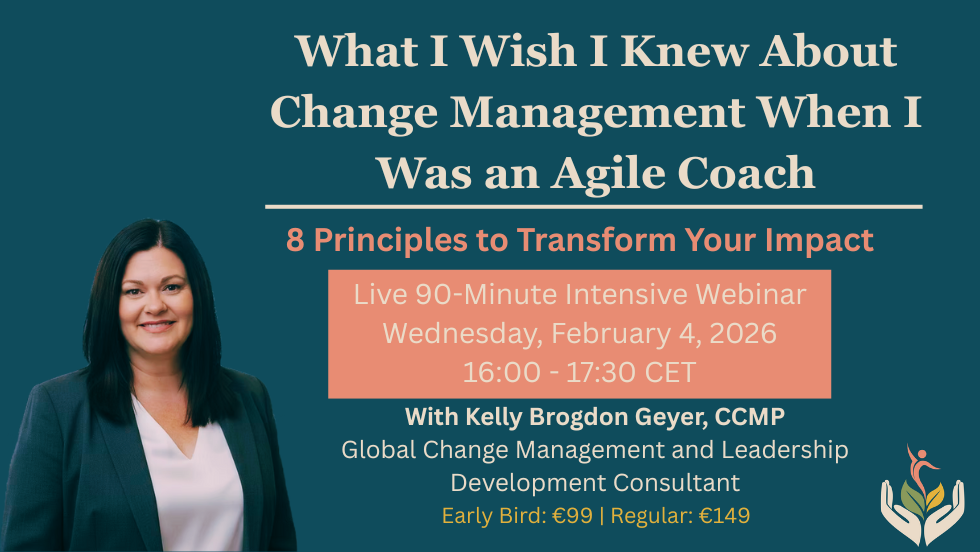
On February 4, 2026 at 16:00 CET, I'm running a 90-minute intensive session specifically for agile coaches:
I'm covering the 8 change management principles that separate team facilitators from transformation leaders:
Executive sponsor activation (not just engagement)
Resistance diagnosis (5 types you need to know)
Strategic stakeholder communication
Designing for sustainability
And 4 more essential skills
You'll get:
The frameworks to diagnose what's really blocking your transformation
Templates and tools you can use Monday morning
A 35+ page implementation toolkit
This isn't about getting certified. It's about filling the gap that's been sabotaging your work.
Because the funeral is over. It's time to build what comes next.
And what comes next needs people who can do both: facilitate agile practices and lead organizational transformation.
The market is ready. The question is: are you?
Kelly Brogdon Geyer, CCMP, is a change management consultant and former agile coach with 20+ years leading transformations across 22 countries. She's seen agile succeed brilliantly and fail spectacularly, and has learned that the difference is always change management, not methodology.


Comments